Writing isn’t just a craft; for many, it is a lifeline for survival.
In this live interview, writing expert Mark Schultz sits down with Steve Schuler to uncover the personal history behind his memoir and short stories.
From using a hidden notebook as a child to survive a dysfunctional upbringing to reading his life’s chapters at the bedside of his late wife during her battle with cancer. Steve opens up about how putting pen to paper became his ultimate survival tool. What follows is a raw, moving, and comforting conversation about grief, healing, and the uncanny, unexplainable signs that follow us through life.
This is a transcript from a live interview with Steve Schuler—Mark’s first question.
“Please, tell us more about yourself. Perhaps something a little bit beyond your bio.”
Steve
First, thank you, Mark, for this interview.
What most people don’t know about me is my passion for riding a bicycle. On my fourth birthday, my grandfather, Westley Schuler, gifted me a bike, and it changed my world. I still ride today at the age of seventy-five. My typical daily ride is 25 to 40 miles, for a weekly total of more than 100 miles. My wife also rides, and we do charity rides a few times yearly. They are usually 100 miles. Riding is very meditative, and I carry a voice recorder to capture my thoughts for future writing. Other than bicycle riding and writing, my other passion is music. I play guitar, although not very well. The learning process is endless; you can never own it. The same holds true for writing.
Mark
“Riding is a good activity. The voice recorder is a great idea. Music is another wonderful creative expression. Many authors are involved in music one way or another. Me? I play the stereo.
New questions. “Are you a full-time or part-time writer?” “What kind of work do you do if you are a part-time writer?
Steve
I am not a full-time writer, but I write nearly every day. Much of it is personal or political ideology. Sometimes an unusual experience motivates me to write. Because of my background in psychology and mental health counseling, I’m curious about behavior. I tend to study people, but not in a creepy way (so, say I). I have dabbled in writing comedy and often think I should try stand-up. I work part-time managing rental properties but don’t have regular work hours. My wife works full-time, so I handle household duties. But I’m not a kept man. My wife, Lisa, may disagree.
Mark
“People are funny, and they offer nearly inexhaustible source material for students of human behavior, and that includes pretty much every writer that has ever lived.”
New question. “How has writing changed your life?”
Steve
Great question. Writing began as a means of survival for me. In my memoir, I write about growing up in a dysfunctional family and being unable to express myself openly. At an early age, I began writing about what troubled me. Sometimes, it would be one or two sentences. I would then rip it up and throw it away before my father could find it. Eventually, writing became a form of self-therapy, and I found I had a lot to say. Part of my memoir was written during the ten months my wife, Linda, was battling cancer. I would write and then read to her. It was our life story and a wonderful time to share and reminisce. I would be a very angry old man if I couldn’t process my thoughts in writing.
Mark
“Wow. It is a deep question, without a doubt. I suspect that writing is a life-altering experience for many authors. Quite a few have told me they write to quiet or express the voices in their head. I suspect doing the latter allows the former to occur. Reminiscing with a loved one is beneficial and can build harmony for both.
New question. “Does your work, past or present, have any influence on your writing?”
Steve
The first thing that came to mind when I read your question was that work has hampered my writing. Unlike the guy in the circus who can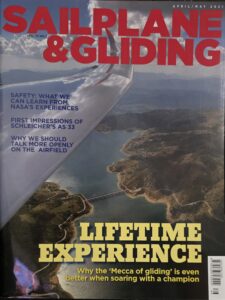 keep ten plates spinning on a pole, I can only focus on one or two. Admittedly, work has financially allowed me to pursue hobbies that have been an excellent source for writing. I have two short stories published in national magazines—one about my first solo in a sailplane and the other about a sailing adventure that went so wrong I almost drowned. So, the short answer is no; work only gave me the time and money to follow my passions.
Mark
“That is a great perspective. Many authors respond as you first thought. They complain that work gets in the way of writing more, and they wish they could write full-time.” “Congratulations on those short stories being published.
New question. “How long had you been writing before either of those stories were published?”
Steve
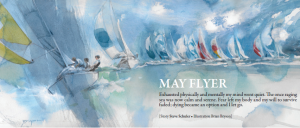
I began writing with intention about four years before my first story, Mayflyer, was published in 2016. A friend invited me to join a writer’s group that meets every Saturday. At first, I didn’t read much because I lacked confidence. When I had the chance to read my sailing story to the writer’s group, one member suggested I send it to a sailing magazine. I sent a query letter to two magazines. One said the word count was too high; the other bought my story. That day, I moved from a guy writing short stories to an author with conviction.
Mark
“Good story and a good friend. He saw something in you, and his faith provided the leverage you needed. I love it.
New questions. “Did you do any research on writing query letters or merely try to follow their requirements for submitting a story?” “Are you still in the writers group?”
Steve
I am naive when it comes to marketing and promoting my work. I emailed the editor and gave them the gist of the story and the word count. That was all, nothing sophisticated or very professional. I am not in the writer’s group anymore. It was cliquish, and I didn’t fit the mold. Oddly, it was helpful. They reviewed my writing critically while they tended to lather praise on those who were friends. It wasn’t terribly bad, but it was obvious, at least to me. I benefited from solid criticism, and I deserved it.
Mark
“The learning curve can be steep when embarking on a new adventure. Writing is a grand and glorious adventure, one that can never be won, but your writing can always improve.” “Your experience in that writer’s group is similar to many others. In some groups, the leader is the only one who is published, and some leaders like to keep it that way. Not all groups are bad, by any means, but those are common complaints.” New questions. “Have you ever seen a ghost or had some other type of supernatural experience?”
Steve
I have never seen a ghost, but I’ve had some unexplainable experiences. A framed photograph of my son and his family walking on a beach is on our fireplace mantel. One day, we found it lying on the floor; the glass was cracked, and sand was scattered across the floor. After a closer look, we realized it had hit another framed photo displayed on a plastic stand. That stand was weighted down with sand, and it had broken. Since it was on the mantel for many months, how it slipped off is a mystery. And the sand? Somebody has a sense of humor.
Another unusual experience happened two days after my wife passed in 2013; it was September 29th. I was reminiscing through a file folder labeled “keepsakes.” I found an old, yellowed envelope addressed to me. Inside was a handwritten poem my grandmother wrote after her husband died. The title was “How Long Shall I Weep.” It was dated September 29th, 1967. Forty-six years to the day, I held that poem in my hand, and I cried. A more detailed version will be in my second memoir.
Mark
“Those unexplained occurrences are interesting, without a doubt. I would cry also. Hearing from your grandmother like that must have brought you some comfort.”
New question. “How many drafts did your book go through before publishing?”
Steve
Far too many, six or more. The first revision was brutal, but the rest were refinement. I am never satisfied with my writing. I let my writing cook for a day or two, then reread it and make changes. That can go on endlessly. I learned to make myself quit.
Mark
“Six or more? Some authors finish in double-digit drafts. Some new writers try to produce a perfect first draft, which is an exercise in futility and frustration. Frequently, the writer gives up because their first draft can’t begin to compare to a well-edited, published book. Striving for perfection with an unending series of edits is something many authors struggle with. Some use it as an excuse to avoid publication because they are afraid their book won’t sell.”
Survival from an early age
New question. “Who designed the cover of your book?”
Steve
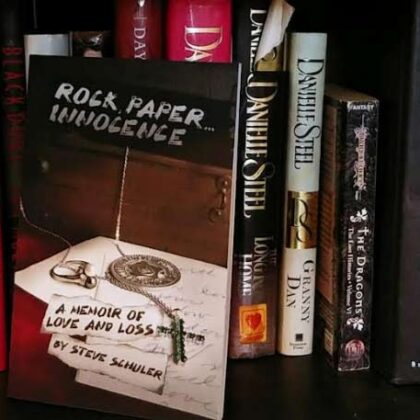
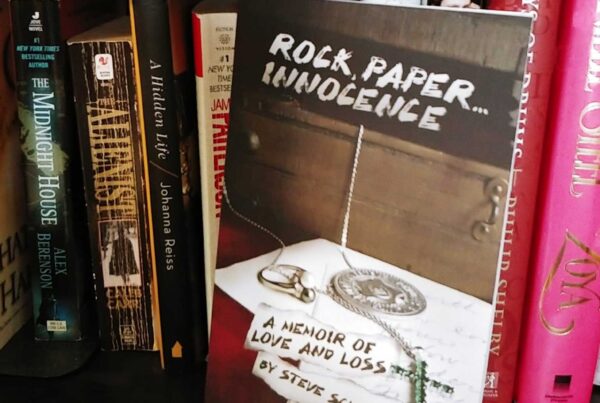
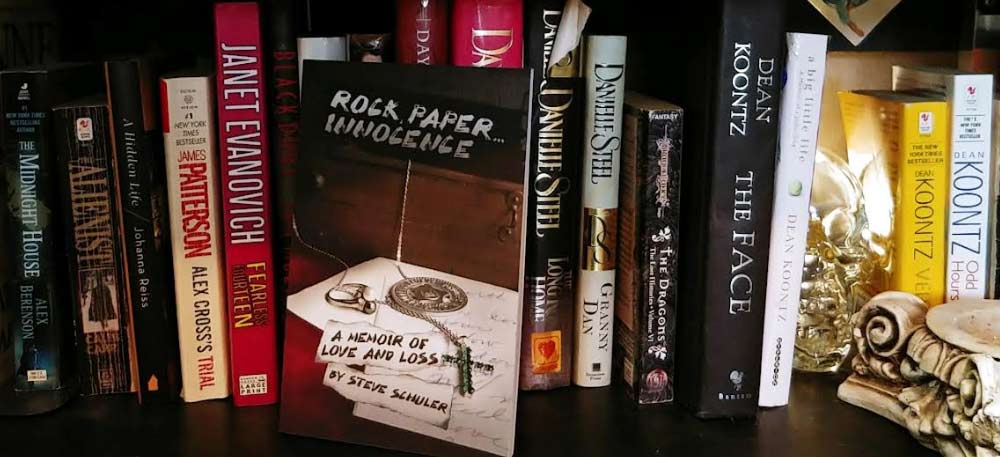
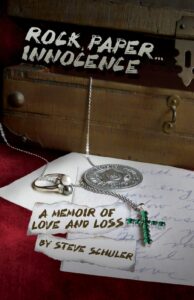
I designed the cover. Each item pictured is part of my story. The emerald cross was a gift from an aunt when she found out Lilla was pregnant. The medallion became key in our relationship during a day at the Michigan State Fair. The pearl ring represents a turning point in our relationship. The paper was the first handwritten page marking the beginning of our story. I put the items together, took a photograph, and sent it to a graphic designer. He added the text.
Mark
“The cover represents your story quite well.”
New questions. “Was it hard to come up with the title?” “What was the process?”
Steve
The essence of the title, Rock, Paper, Innocence, is revealed within the story. In the 1960s, the game rock, paper, scissors was quite common. Balling your fist represented rock. Holding your hand flat indicated paper, and two spread fingers suggested scissors. Rock crushed scissors, paper covered rock, and scissors cut paper. My default choice was rock, and Lilla knew it. When we played that silly game, she would always be paper. Lilla was gentle and compassionate. She was the only person I would intentionally let win.
In a way, the game represented our personalities. I learned that harshly when a bunch of teenagers attacked me while at the state fair. I was on the ground, my nose bleeding, while Lilla hovered over me. It was a life-changing moment: me, the rock, being protected by Lilla, always the delicate paper. It was the first time I experienced that much compassion and protection. Innocence represents the baby we brought into this world. It was an unsettling time, and our relationship was torn apart.
Mark
“I recall the state fair scene; it was disturbing and brutal. Innocence certainly describes a baby. That is beautiful.”
New question. “Who was the first person to inspire you to write?”
Steve
Two people come to mind. The first was an author who stimulated my desire to read, and I loved to read. The author was Alexandre Dumas, and the book was The Count of Monte Cristo. It was written in 1846. Reading became my way of escaping the world I felt trapped in as a child. While I fell in love with the art, I didn’t believe I had the talent or ability to write. But I could read, and I had the time.
My second inspiration came from an English teacher. In my thirties, I returned to school and received an AA in general education. I took the core classes, skating through them while working to raise a family. After a short story writing assignment, the teacher returned my graded paper. Although she gave me an A, a couple of questionable red marks indicated grammar or spelling errors. I didn’t know what they meant, so I asked her about them after class. She started rereading my paper and finding other errors.
Kidding, I asked her, “Are you going to change my grade? She said, “No, I got caught up in your story, and I didn’t notice some of these mistakes. You have a writing style that keeps the reader in the story. But you do need to work on your punctuation and spelling.” I am still poor at spelling and never know where to put the commas.
Mark
“Reading was my escape as a child also. The English language is so complex, and a lot of it doesn’t make sense. It has absorbed bits and pieces from so many other cultures and times that one thing or another doesn’t fit logically with the others. Commas are the most misunderstood punctuation mark in my mind, next to the ellipsis, perhaps. With so many rules for commas, don’t beat yourself up too much.”
New question. “How long had you been writing before the first short story was published?”
Steve
I am old enough to say I began writing long before the invention of computers. If something exciting or unique happened, I would write about it. Often, I could barely read my writing because my thoughts flowed faster than I could write. My wife says I scribble like a doctor. The first short story, Mayflyer, was handwritten ten years before its 2016 publication. There were so many misspellings and questionable words that it was barely readable. I still prefer writing in cursive since I type at about 2 MPH.
Survival at sea, Steve Schuler
Mark
“I certainly understand about words flowing faster than the hand can write or type. My cursive handwriting is nearly illegible if I am in a hurry. My typing is probably five words per minute. When spellcheck first came out, I thought my proofreading career was over. It didn’t take long for me to realize my fears were unfounded. I am good at finding the spelling errors.”
New questions. “Is this your newest book?” “Will you be writing more?”
Steve
Rock, Paper, Innocence is my last published book. I have two books in the works: one is a follow-up to my first memoir, with the working title Rock, Paper, Defiance. The second is a collection of anecdotal stories and training experiences from my competitive bicycle racing days. The working title is Cycle Life-Eight to Eighty. My writing is a bit stalled since I’ve spread myself too thin.
Mark
“Your fans will be glad to know that. Readers always like to know that their favorite author will write more.”
New questions. “What do you think of the current controversy regarding AI?” “Did you use AI in any of your writing or planning for your books?”
Steve
I haven’t delved into the dark side of AI writing. People who pump books out for financial gain may be the first to go there. I can’t even imagine how AI will sell your soul. I write because I have something to say, and want to say it my way. My preference is MS Word for spelling and common grammatical errors, but Grammarly is a also a great tool for writers.
Good writers have a unique voice, and writing software messes with that. The best tool is to write your own story and work with an editor who knows your style. Great writers all have a distinct style. I was a fan of James Patterson, but his move to grind out books with co-authors has tainted him. Honestly, I am behind the curve when it comes to the latest technology. But for now, I am not in a hurry; there are lumps in the batter, and the temperature is not right.
Mark
“Artificial intelligence is overblown by most people. A short story can be written in the style of almost any major author because AI has been fed thousands of e-books easily available on the internet. The AI cake is severely undercooked; don’t rush out to buy anytime soon.”
New questions. “Have you encountered a troll reviewing one of your books?” “How did you handle it?”
Steve
No, but a personal troll could be funny if they weren’t too malicious. A family member anonymously followed me on Twitter. I found out he was following me under a pseudonym when he criticized me at a family gathering for something I posted. At first, he seemed embarrassed when he realized he had outed himself by mentioning the tweet. He knew I knew.
Mark
“Most of the trolls are very malicious, unfortunately. When they do leave some semblance of a review, it’s easy to see they didn’t read the book. I suggest authors welcome a negative review or two. A negative review proves that the other reviews are not products of a family member or friend.”
Last question. “What was the first paying job you worked as a kid, and how old were you?”
Steve
My first job was cleaning pots and pans, clearing tables, and sweeping floors in a doughnut shop. I made a dollar an hour and a free breakfast. The waitress gave me fifty cents from her tip money. I worked that job on Saturday and Sunday mornings. I was fourteen years old. I also worked Friday nights at a local liquor store, stocking coolers and fronting shelves.
One night, I forgot my jacket and nearly froze to death. The walk-in coolers were kept at around forty degrees. The shop owner paid me two dollars, no matter how long I worked or how much I suffered. He also gave me a Coke, which was ten cents. At first, it took more than three hours to get the job done. Eventually, I got it down to under two hours on most nights.
Mark
“In the 60s, a dollar an hour was a good wage for a teen. I am sure you never forgot your jacket again, either. That was very cold!”
“Thank you, Steve, for being a wonderful guest on the Word Refiner channel. Not only did I enjoy your book, but chatting with you has been awesome!” Until next time, keep on writing.
Steve
Thank you, Mark,
You are a gracious host and an incredibly awesome interviewer. Your questions were thought-provoking and took me down old paths I’d forgotten. This interview process has been a confidence builder for me. Write on, Steve Schuler